Remember how the Manhattan Project changed the world in 1945? It wasn’t just about a bomb; it was about who got to set up the rules for the next 80 years. Well, move over to Uranium. In 2026, the new world order is being printed on silicon chips.
Right now, we are in the middle of a high-stakes “Chip War” between the USA and China. And trust me, this isn’t just about anyone who has a faster smartphone. It’s a battle for survival.
The “Root”
Imagine a machine with the size of a double-decker bus that can print patterns 10,000 times thinner than a human’s hair. That’s the ASML TWINSCAN EXE:5000. It’s the only machine in the world that can make the “super-brains” needed for the next generation of AI.
The USA and its allies (like the Netherlands and Germany) have the keys to this machine. And they’ve told China: “You’re not on the list.”
If someone told you that you couldn’t buy the most important tool for your future, what would you do? You’d build your own. That’s exactly what China is doing. They’ve launched their own “Manhattan Project of Chips” to build an ecosystem from scratch, everything from the power plants to the machines themselves. They are even offering $700,000 signing bonuses to recruit “Master Builders” (former engineers from ASML and Zeiss) to come to China and help them to build machines.
The USA has the world’s best chips (NVIDIA/Intel), but it is struggling with an old power grid. China has the opposite situation: their chips use more power, but they have a world-beating power ecosystem to feed them.
Cheap Power & The Heat Problem
Chinese chips (like Huawei’s) are currently less energy-efficient than American ones. This creates two problems: they get much hotter and they consume more electricity, which makes it expensive to run.
China came up with a smart solution. They reduced electricity bills by 50% for data centers, but with one condition: they must use domestic Chinese chips. If you use a foreign chip, you lose the discount. This helps Chinese chip makers stay profitable and pushes their own ecosystem forward.
Elon Musk recently noted that the world is running out of electricity to power AI, but China is the only place adding power fast enough to keep the “AI lights” on.
How China Generates So Much Power
China knew electricity would be the “fuel” of the AI era. Since 2021, they have added more power capacity to their grid than the entire history of the US power grid. In 2025 alone, they added 543 gigawatts. How are they doing?
1. Nuclear Power Banks
China is building SMRs (Small Modular Reactors) like the Linglong One. These are portable, scalable “mini-nukes” that can be placed right next to an AI data center to give it 24/7 dedicated clean power. China is adding about 10 reactors per year and may pass the USA in total nuclear power by 2030.
2. Mountains of Solar
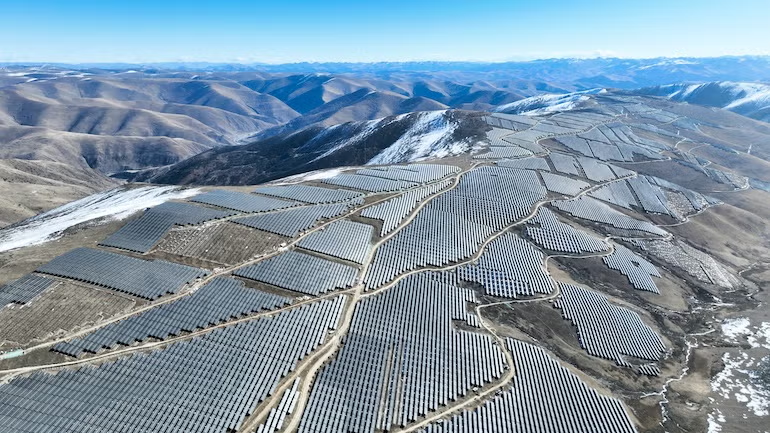
Most people in China live in the East, so the government decided to build massive solar and wind plants in the West. They are covering mountains and deserts with panels. Daily Solar/Wind Production: China produces 6.5 billion units, while the USA produces 2.5 billion and Bharat (India) produces 0.8 billion (We are nowhere in race). China produces nearly as much power as the USA and India combined. Experts predict China will have 400 Gigawatts of spare power by 2030.
The “Bathtub” & “East Data, West Computing”
Because China’s chips get so hot, traditional fans can’t keep them cool. They solved this with “Immersion Cooling.” Instead of using air, they “drown” their AI servers in a special liquid. This “dielectric” fluid doesn’t conduct electricity but absorbs heat 1,000 times better than air. This allows China to pack 10x more chips into one room. Alibaba’s latest data centers in 2026 use zero fans, cutting cooling costs from 40% down to just 2%.
They also use the “East Data, West Computing” strategy. They put their hottest AI clusters in the freezing deserts of Inner Mongolia and Xinjiang. Naturally cold air and cheap renewable energy save billions in cooling costs.
“Quantity over Quality” Strategy
China’s ecosystem is built for scale. Because they have cheap, overflowing electricity, they don’t need the “perfect” chip to dominate. Even if a Chinese chip is 30% less efficient than an NVIDIA chip, China doesn’t care. They just plug in 30% more chips because the power is cheap, and the grid can handle it.
China is winning the race to put AI into physical things: robots, smart factories, and city infrastructure. They are building an “Army of AI” that is “good enough” rather than one single “Super Genius.”
The Wild Card: DeepSeek
We used to think you needed the most expensive chips to have the best AI. In 2025 and 2026, a Chinese company called DeepSeek changed the rules. This team proved you can build a “Super Brain” on a budget by being smart and efficient instead of just throwing money at hardware. It’s like winning a race with a cheaper car because you’re a better driver.
Research Brains vs. Physical Workers
There is one bigger difference. What are they building AI for?
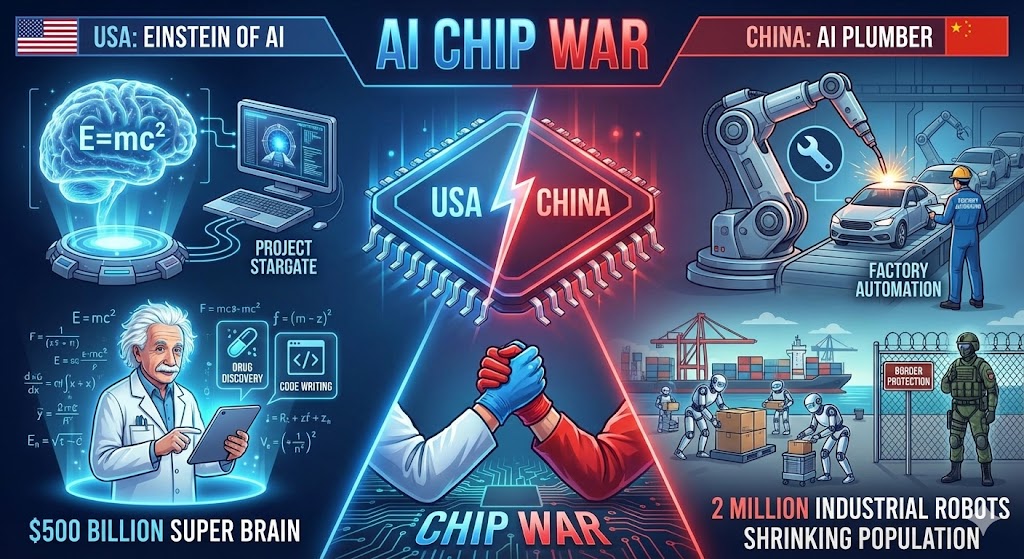
The USA (AGI): They want to create the “Einstein of AI.” They are building a digital “Super Brain” to solve science, discover drugs, design complex machines and write code. Look at “Project Stargate”: a $500 billion US effort to build the world’s most powerful computer.
China (Embodied AI): China says, “We don’t need a writer; we need a plumber.” China is the “World’s Factory” with 2 million industrial robots. Because their population is shrinking and aging, they need AI to weld cars, sort ports, protect border, and manage the power grid.
China is even testing AI in defense. They have deployed “Assistant Officer” robots near the Vietnam border. These 1.76-meter-tall robots handle surveillance and logistics, and they can even swap their own batteries to patrol 24/7. They are also developing “Mirror Mode” robots that replicate a human soldier’s movements in milliseconds, keeping humans safe while the robot fights.
Why 2027-28 is “Judgement Day”
The next 12 to18 months will tell us everything.
The USA has spent hundreds of billions building massive “mega-factories” in Arizona and Ohio. If those factories start mass-producing 1.8nm chips by 2027 and fix their power grid issues, the USA secures its crown. But don’t count China out. China wants to produce 70% of their chipmaking tools domestically by 2027. If they can mass-produce 3nm or 5nm chips using 100% Chinese parts, the USA’s sanctions will have failed.
In 1945, the biggest bomb was ruled the world. In 2027, the best Chip Ecosystem will decide who makes the laws, who runs the economy, and who owns the future.
What do you think? Is it better to have the most “powerful” hardware (USA) or the most “efficient” software and power (China)?