Imagine building a massive global empire where every piece of high-tech machinery relies entirely on one secret ingredient. Now, imagine that you control almost 90% of that secret ingredient. For the last two decades, China has lived exactly this reality. The ingredient? Rare earth elements. The empire? The global Electric Vehicle (EV) market.
Every time an electric car accelerates smoothly on a city street anywhere in the world, a heavy dose of rare earth minerals, like Neodymium and Dysprosium, is working behind the scenes. Without these metals, the high-performance permanent magnets inside modern EV motors simply cannot exist. Global automakers have spent billions trying to find a workaround, desperate to break free from this absolute geopolitical chokehold. Yet, time and again, they hit an engineering brick wall.
Until now.
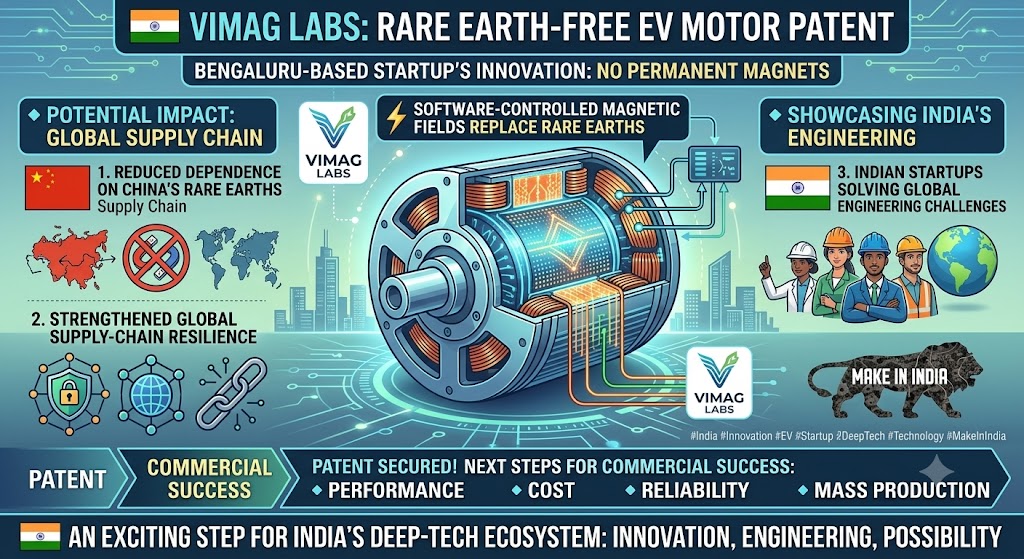
In a stunning technological leap, a deep-tech startup operating out of the tech hub of Bengaluru, Bharat, might have just cracked the code. Vimag Labs has officially secured a groundbreaking Indian patent for a rare earth-free electric motor platform. Instead of heavy physical magnets, their design replaces hardware with intelligent, software-controlled magnetic fields. It is a genuine paradigm shift. If successfully scaled, this domestic breakthrough could single-handedly collapse China’s monopoly on the EV supply chain and position Bharat as a global leader in clean-tech innovation.
The Magic Under the Hood: The “Virtual Magnet” Breakthrough
To truly understand how massive this achievement is, we have to look closely at standard EV engineering. Most electric vehicles on the road today utilize a Permanent Magnet Synchronous Motor (PMSM). Inside these motors, the rotor (the spinning part) is lined with incredibly strong, physical permanent magnets. These magnets generate a persistent magnetic field that interacts with the outer copper coils (the stator) to create the torque that drives the wheels. They are efficient, compact, and powerful, but they come with a terrible supply chain burden.
Vimag Labs looked at this problem and decided to change the fundamental rules of automotive design. They engineered what they call the Virtual Magnet Synchronous Motor (VMSM) platform. The patent—titled “A Robust Rotating Transformer Excited Synchronous Motor and Its Control” protects a completely novel architecture.
How does it function without magnets? The engine replaces the physical permanent magnets on the rotor with specialized copper windings and an advanced power electronics module. By utilizing proprietary software algorithms, the system generates and regulates a dynamic, “virtual” magnetic field on the rotor in real-time. It acts exactly like a traditional magnetic motor, but the magnetism can be instantly dialed up, adjusted, or turned completely off with a single line of software code.
“We are replacing fixed, heavy, expensive metal magnets with clean, lightweight copper windings and hyper-intelligent software. It is the ultimate evolution from hardware-reliant engineering to software-defined mobility.”
Historically, building a magnet-free motor meant dealing with massive engineering compromises. Automakers could build “wound-rotor” motors, but they required mechanical slip-rings and brushes that rub against moving parts. These components wear out quickly, create friction, and demand constant maintenance. Alternatively, induction motors could be used, but they are traditionally bulkier, heavier, and less efficient at lower speeds. Vimag Labs has bypassed all of these legacy flaws. Their VMSM design is completely brushless and slip-ring-free, delivering the precise high efficiency and power density of a permanent magnet motor without a single grain of rare earth material.
Why This Matters: Crushing the China Monopoly
Let’s talk pure geopolitics. Why is the entire automotive world panicking about rare earth magnets? It all comes down to processing dominance. China does not just mine a vast portion of the world’s rare earth elements; it dominates the chemical processing infrastructure required to turn raw ores into high-grade magnets. Over 85% to 90% of the world’s EV motor magnets pass through Chinese processing facilities.
This reality leaves the global automotive industry incredibly vulnerable. A minor diplomatic dispute or an export restriction from Beijing could instantly freeze EV assembly lines across Europe, North America, and Asia. For a country like Bharat, which is pushing hard for complete EV adoption across two-wheelers, three-wheelers, and public transport, relying entirely on imported Chinese components is an economic and national security nightmare.
Vimag Labs’ technology shatters this monopoly. By substituting complex rare earth magnets with standard, widely available copper and intelligent semiconductors, they have removed China from the core equation of EV power production. It allows domestic manufacturers to build entire powertrains using local materials. This is not just a win for a single startup; it is a structural shield for the entire Indian manufacturing ecosystem against global supply chain manipulation.
The Cost and Engineering Advantage for Bharat
For an emerging economy like Bharat, cost is everything. The Indian automotive market is intensely value-driven. If an EV costs significantly more than a traditional petrol or diesel vehicle, mass adoption will stall. Rare earth magnets are incredibly expensive, and their market prices fluctuate wildly based on geopolitical tensions.
By moving the entire system over to a software-defined architecture, the economics change completely. The VMSM platform drastically simplifies the bill of materials for an electric motor. Copper and silicon chips are far more predictable in pricing and much easier to source globally than specialized Neodymium magnets. Furthermore, because the magnetic field is controlled via software, the motor can be optimized in real-time for different driving conditions. Whether a driver is navigating stop-and-go traffic in Mumbai or cruising down an expressway, the software ensures the motor operates at peak efficiency, extracting maximum range from the battery pack.
From the Lab to the Assembly Line: Scaling Up
A brilliant laboratory prototype means nothing if it cannot be mass-produced efficiently at an automotive scale. Thankfully, Vimag Labs is already moving far past the theoretical stage. The engineering behind this platform is the result of a massive commitment, more than 87,600 intensive engineering hours. This dedication has culminated in 5 granted patents, 10 more under close review, and 15 registered trademarks.
The startup has also secured the financial runway and industrial partnerships needed to make a commercial dent:
- Institutional Backing: Vimag Labs recently closed a robust $5 million Series A funding round led by global venture giant Accel, with participation from Chakra Growth Fund and Thinkuvate. This capital injection provides the resources necessary to transition from design to full-scale industrial testing.
- Manufacturing Muscle: They have inked a strategic Manufacturing Memorandum of Understanding (MoU) with Jendamark Pvt. Ltd. This partnership guarantees the industrial automation expertise required to build high-volume, automotive-grade production lines.
- Real-World Pilots: The technology is already being integrated into live pilot programs with major Indian two-wheeler and passenger vehicle manufacturers. Real-world validation on Indian roads is currently underway.
A Scalable Blueprint for the Future of Transport
The true beauty of a software-defined motor platform lies in its dynamic scalability. The core architecture Vimag has patented is not limited to lightweight scooters or compact city cars. The startup is already designing variations of the VMSM architecture to scale up into heavy commercial vehicles, long-haul electric trucks, and massive industrial infrastructure ranging from 200 kW to 600 kW power outputs.
Beyond standard roads, a magnet-free, highly durable motor is perfect for high-reliability sectors like robotics, autonomous defense systems, marine propulsion, and advanced industrial cooling systems. By removing physical magnets—which can crack, degrade under extreme heat, or lose their magnetism over time—Vimag has created a rugged motor platform built to survive harsh environments.
Conclusion: Bharat’s Leapfrog Moment
For decades, the global narrative around technology development followed a familiar script: Western nations innovated the core science, China scaled up the manufacturing at an unbeatable cost, and countries like Bharat merely consumed the final product. The EV revolution was on track to follow this exact blueprint, trading an old dependency on Middle Eastern oil for a new dependency on Chinese rare earth processing.
Vimag Labs is flipping that script entirely. By tackling one of the most complex engineering challenges in modern clean-tech, this Bengaluru startup has proven that Bharat can innovate at the absolute bleeding edge of deep technology. The VMSM platform is a masterclass in elegant engineering—solving a critical material scarcity issue by using the power of intelligent software code. As this technology hits the production lines, it marks a proud milestone for the Make in India vision, showing the world that the future of clean, independent mobility may very well be coded in Bharat.